| |
How to get 160 aquariums into the flat, and still have room for the bed ??
This is how we did it (back in 2005. There have been LOTS of changes since then).
|
 |
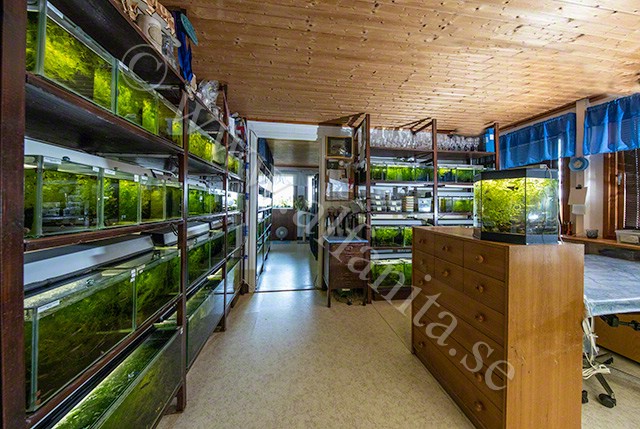
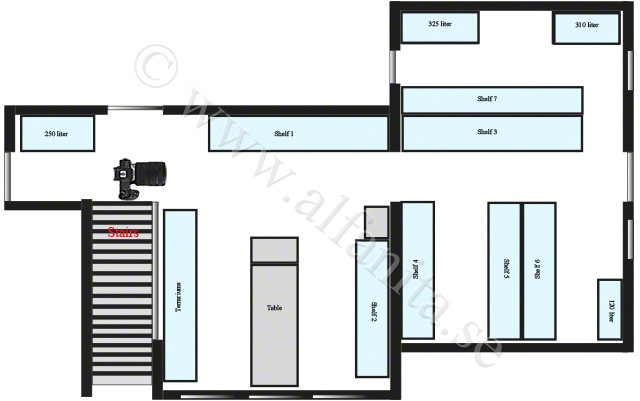
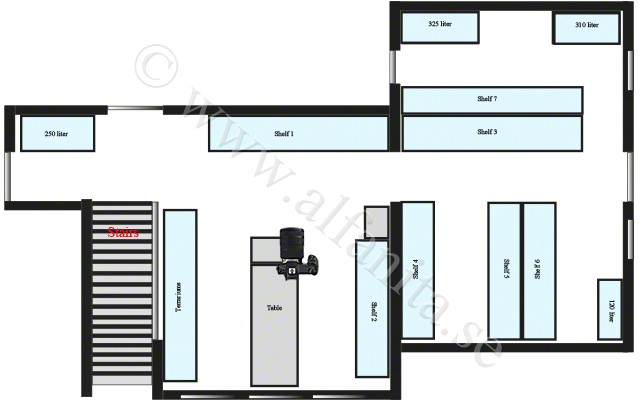
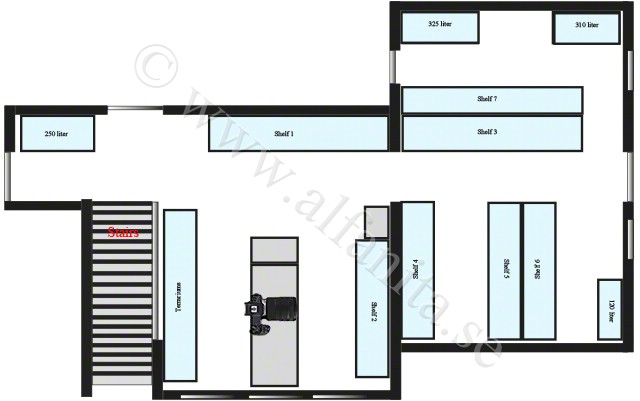
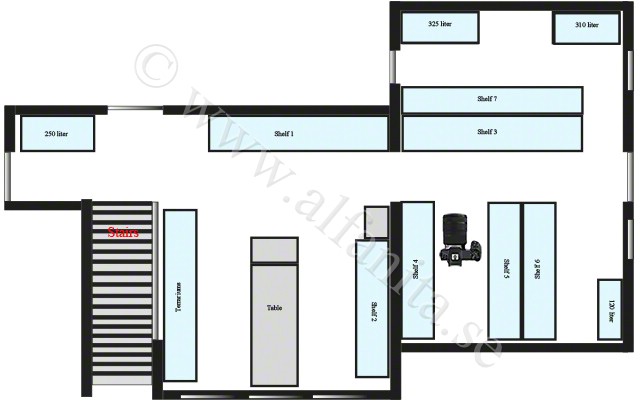
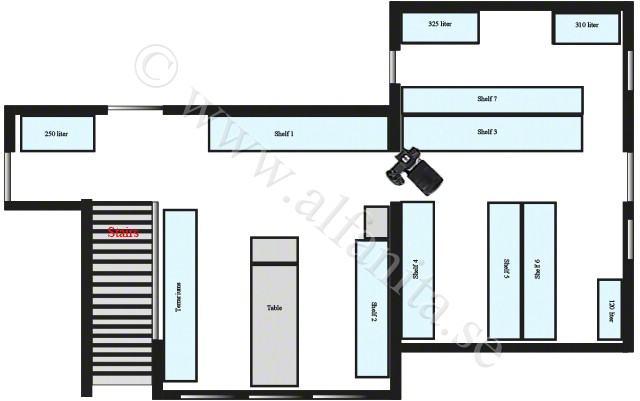
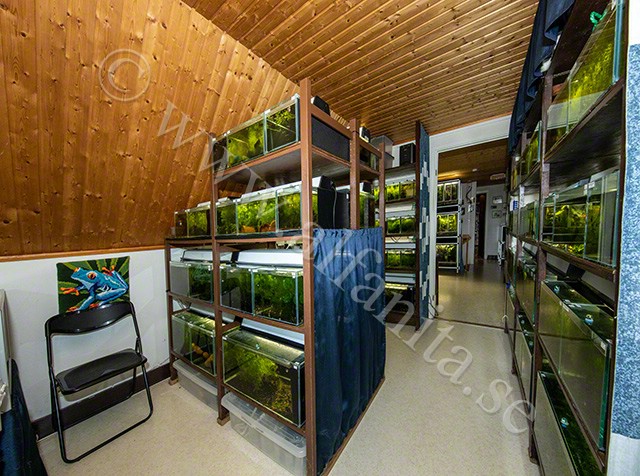
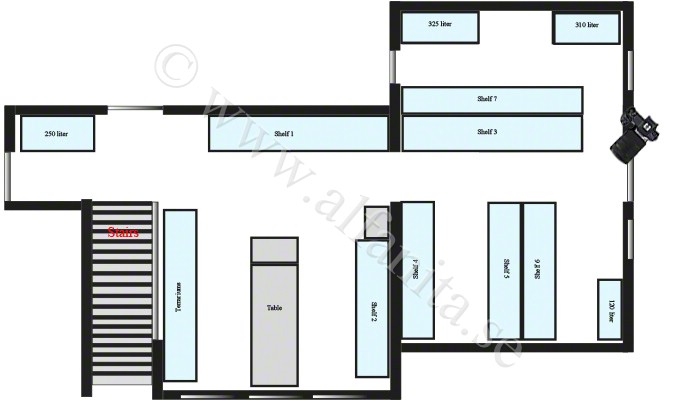
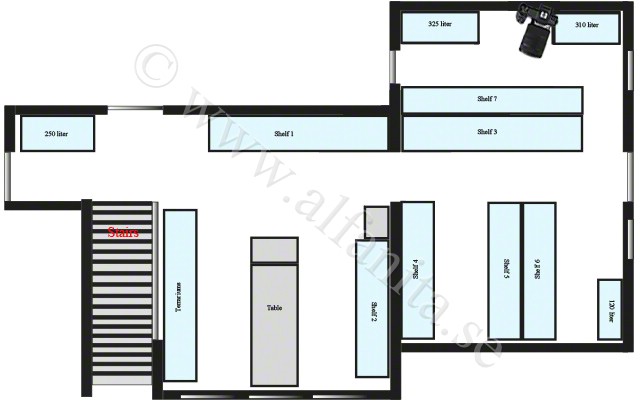
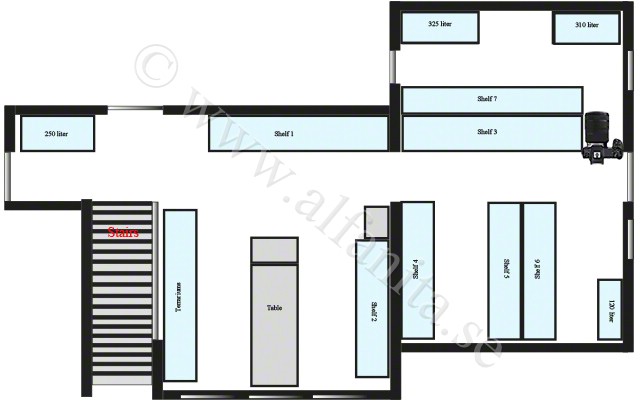
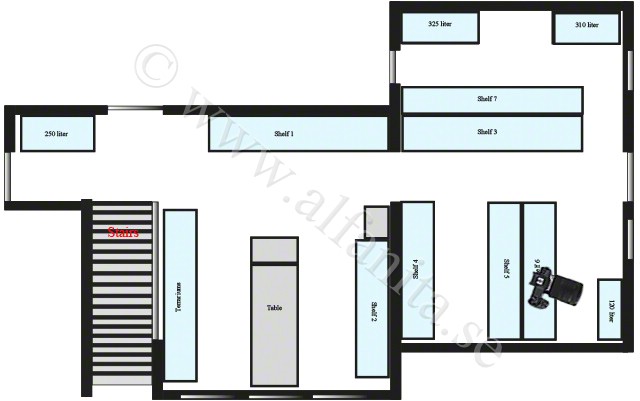
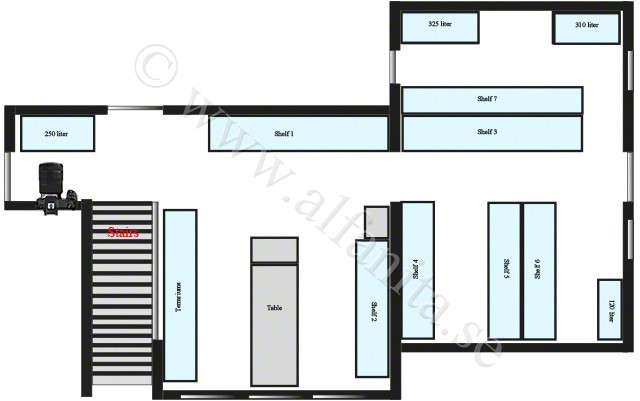
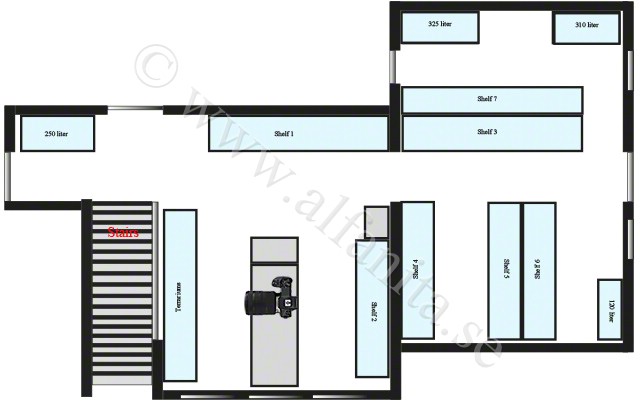
This is what you meet when you enter our "fish room".
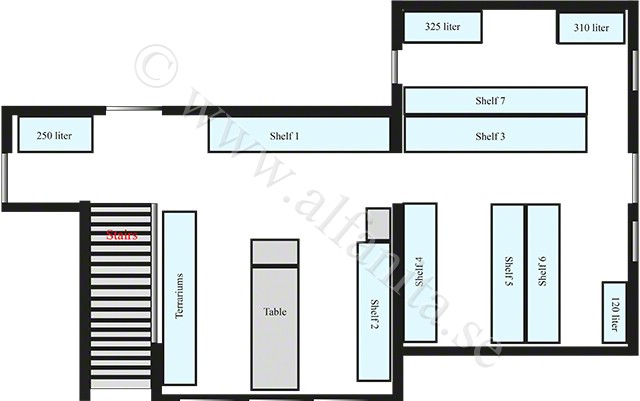
The "fish room" consist of a hall and our bed-room, and
is located on the second floor. This means that it gets quite warm in the
summer, and that can only partly be put right be leaving the door to
the balcony open. It also means that we can never get a lower temperature
than the temperature outside, and that is a limitation when it comes to
choosing species. That is something we have learned the hard way!. |
|
 |
|
|
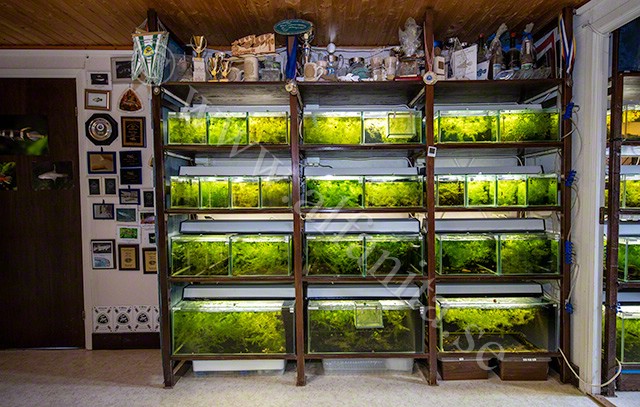
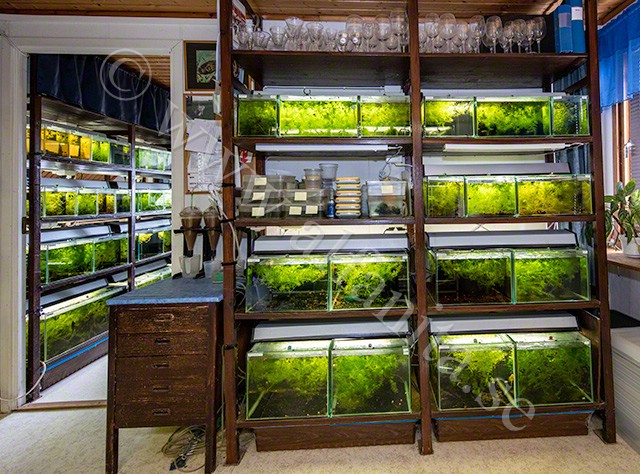
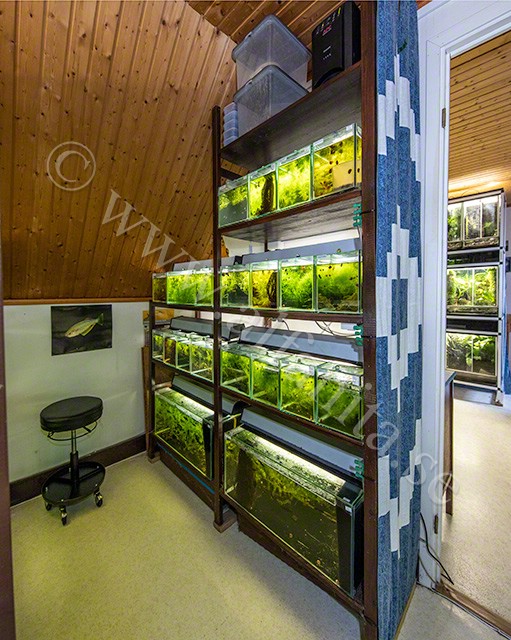
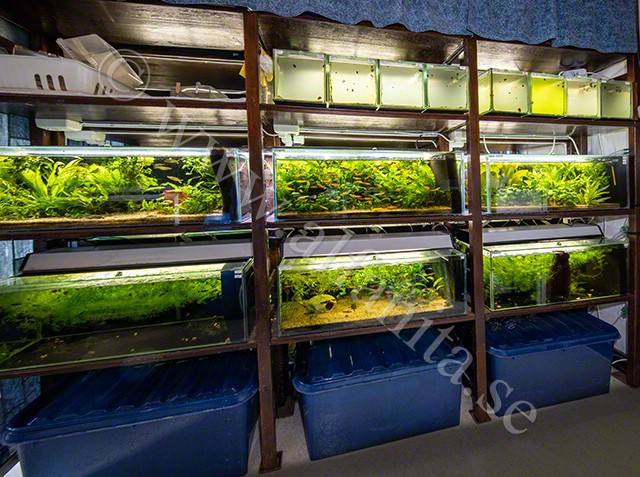
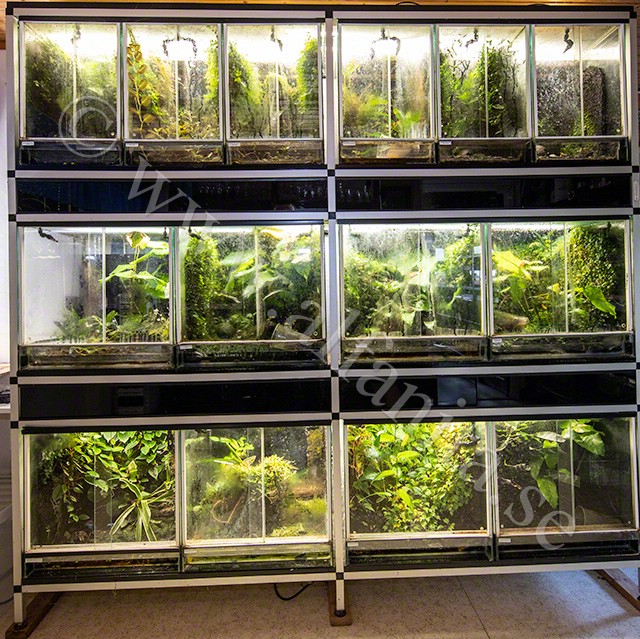
At this level
we have "3 on a shelf" tanks (about 18 litres/4 gallons) with a
pair or a trio of Fundulopanchax
gardneri or larger Chromaphyosemion. |
|
At this level we
have "4 on a shelf" tanks (about 14 litres/3 gallons) with a pair or a
trio of small Fundulopanchax,
Aphyosemion or Chromaphyosemion. |
|
At this level we
have "2 on a shelf" tanks (about 25 litres/6 gallons) with spawning
groups or juveniles. |
|
At the bottom we have the largest tank (45 litres/11 gallons and 85
litres/21 gallons), and on this shelf we have Fundulopanchax nigerianus
"Lokoja", Fp. gardneri
mamfensis "Talangaye, CSK 95/6" and
Fp. gardneri gardneri "Nsukka" |
|
 |
|
|
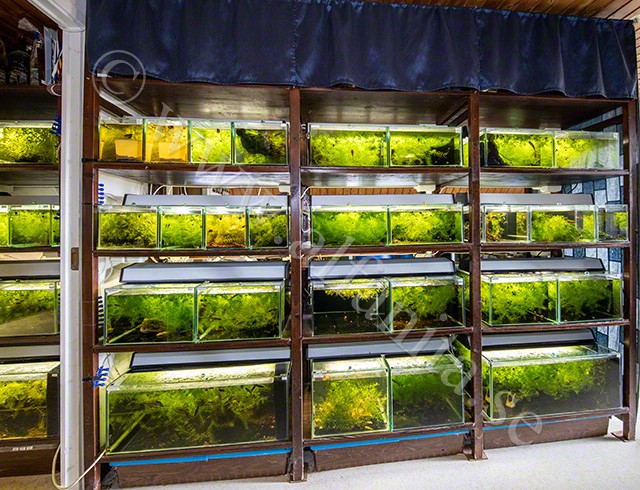
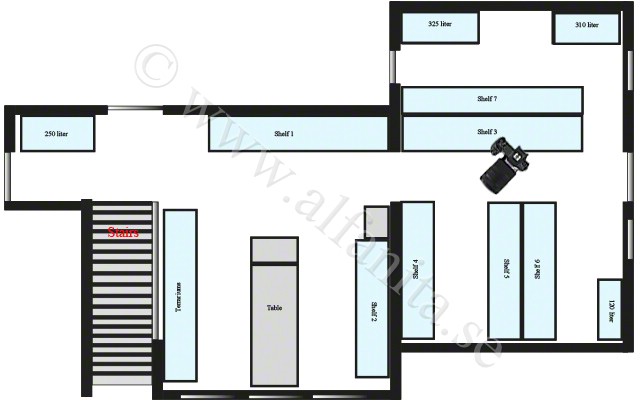
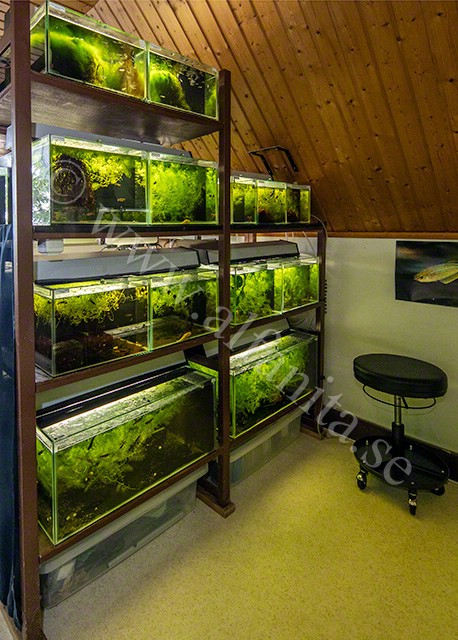
At this level
with "3 on a shelf" tanks (about 18 litres/4 gallons) we have
pairs or a trios of Fundulopanchax
gardneri, Epiplatys or Chromaphyosemion. |
|
At this level we
have "4 on a shelf" tanks (about 14 litres/3 gallons) with a pair or a
trio of Fundulopanchax,
Aphyosemion or Chromaphyosemion. |
|
At this level
we have "2 on a shelf" tanks (about 25 litres/6 gallons) with spawning
groups. |
|
At the bottom we
have the largest tank (85 litres/21 gallons and 45 litres/11 gallons), and
here we have
Fundulopanchax nigerianus
"Misaje", Altolamprologus spec. "compressiceps shell", Fp. spec
"Korup" and Chromaphyosemion riggenbachi "Nkwo, 97/1" |
|
 |
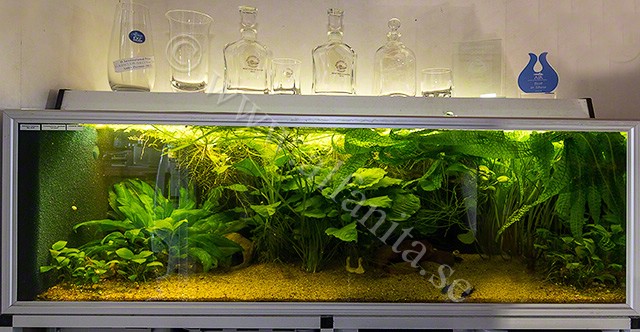
Throughout the years there
has been some awards. |
|
In these "3
on a shelf" tanks we keep Fundulopanchax
gardneri lacustris "C89/5", Chromaphyosemion bitaeniatum "Zagnanado"
and Fp. gardneri gardneri "Lafia" |
Here we hatch
and keep the smallest fry and hatch artemia.
|
|
At this level we
have "2 on a shelf" tanks with spawning groups or juveniles. |
|
At the bottom
we have four 45 litres/11 gallons tanks. In these we keep Fundulopanchax
deltaensis, Fp. gardneri lacustris "C89/5", Lacustricola bukobanus "Mityana. UGJ,
99/17" and
Fp. gardneri mamfensis "Ossing" |
|
 |
This is our cats
Daisy and Esmeralda resting on our bed. |
|
At this level we
have "3 on a shelf" tanks with a pair or a trio of Fundulopanchax
gardneri or larger Chromaphyosemion. |
|
In these "4 on a
shelf" tanks we keep juveniles of all kind. |
|
In these "4 on a
shelf" tanks we also keep juveniles of all kind. |
|
In these larger
tanks we keep larger juveniles or large litter of for instance Fp. rubrolabialis "Malende"
and Fp. filamentosus "Ouidah, Rep. of
Benin". |
|
 |
Our cat Daisy willingly pose
on the bed. |
|
In these "3 on a
shelf" tanks we keep different Fundulopanchax and Chromaphyosemion
species, and also Aplocheilus kirchmayeri "Goa 91" |
|
In these "4 on a
shelf" tanks we keep different Aphyosemion and Chromaphyosemion
species. |
|
In these "2 on a
shelf" tanks we keep different spawning groups of Aphyosemion,
Chromaphyosemion, Fundulopanchax
and Nothobranchius. |
|
In these three 85 litres/21
gallon tanks we keep Chromaphyosemion splendopleure "Moliwe, GPE 90/5", Rivulus igneus "Sentier
du Rorota, GML 96/2" and Fundulopanchax
arnoldi "Ughelli, TR 01" |
|
 |
In the top to
the left we have 8 small aquariums with Moina. |
|
At this level we
have six 32 litres/8 gallon tanks with groups of Fundulopanchax, Chromaphyosemion
and lampeyes. |
|
At the middle
level we have three 65 litres/16 gallon tanks. Among other species we keep Pelvicachromis
species, the rainbow fish Pseudomugil
furcatus and livebearers, all mixed
with killies. |
At the bottom we have
three 65 litres/16 gallon tanks with groups of lampeyes and Fundulopanchax.
We also have some Pelvicachromis species here. |
|
 |
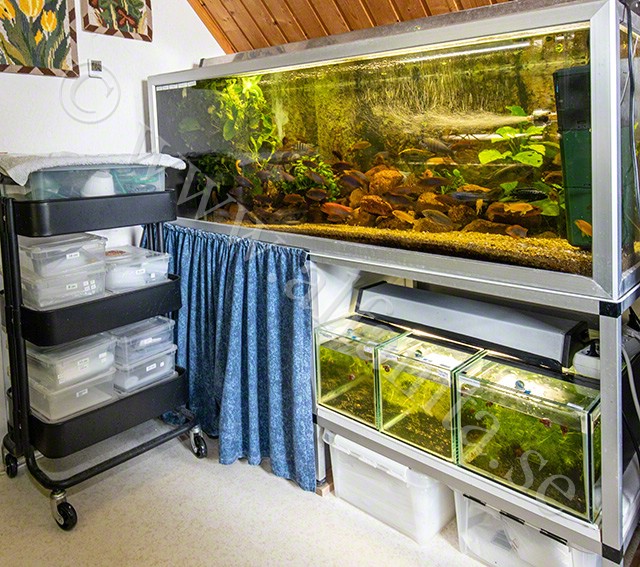
In the two large aquariums (325 and 310 litres) we have juveniles of
cichlids from Lake Malawi. The species we have here are:
Cynotilapia afra "Còbué"
Labeotropheus
trewavase "Manda"
Labidochromis hongi and
Pseudotropheus
msobo "Magunga"
These tanks also acts as water bowl for our cats. |
|
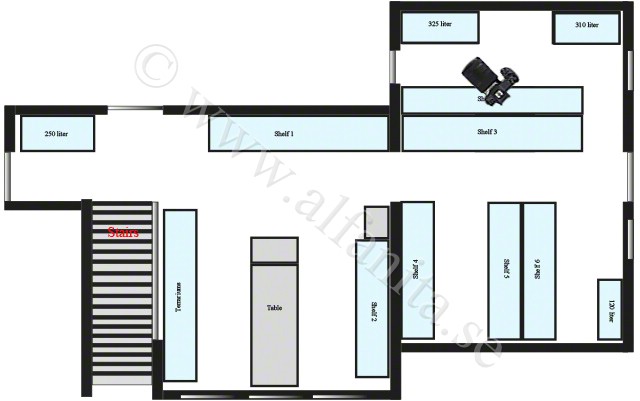
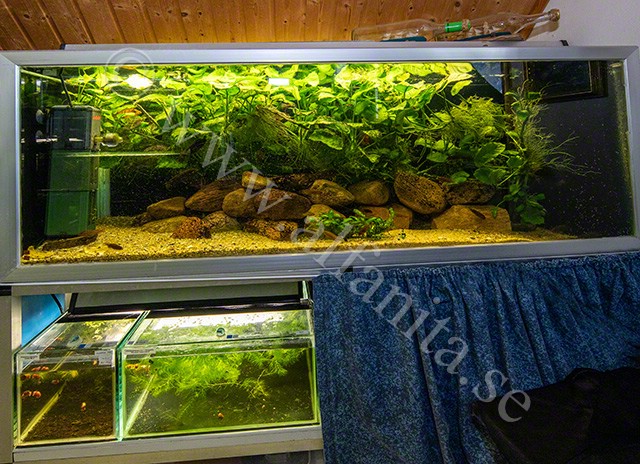
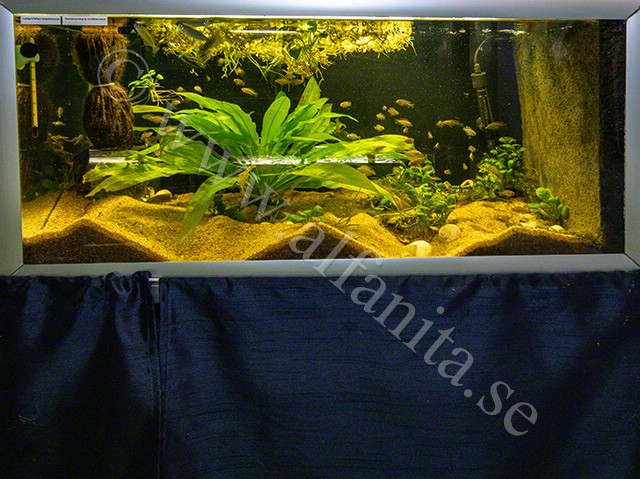
Between the 2 large tanks we
have our both photo tanks. In the ceiling/on the wall you see the rail that
holds the flashes. |
|
Beneath the
large tanks we have some tanks of mixed size. Here we keep a pair or a group
of fishes that like a bit lower temperature (this is the coolest place in
the fish room), or some males growing up to be photo models. |
 |
(Click on the image to see a larger
version) |
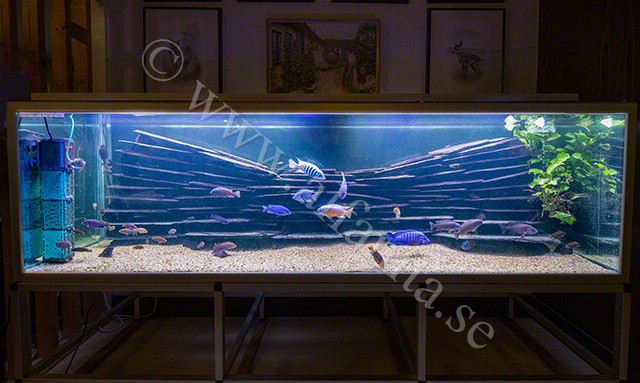
In the
kitchen we have this 720 litres/170 gallon tank with cichlids from Lake
Malawi.
The interior consists of slate that's piled up all from the glass, and they
are not glued together.
This means that one has to be very careful when one builds it up, so it's
really stable.
In this tank we keep
Cynotilapia afra "Còbué",
Labeotropheus
trewavase "Manda",
Labidochromis hongi and
Pseudotropheus
msobo "Magunga" |
 |
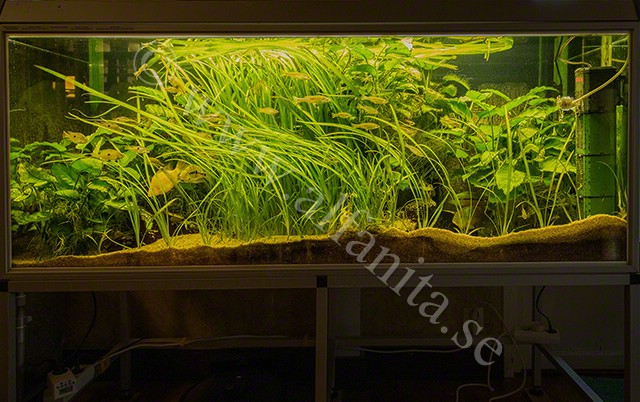
| In the living room we
have this 400 litres/100 gallon community tank. In this we keep Pterophyllum spec. "Peru", Pelvicachromis
taeniatus "Ogelle", Trichogaster leeri, Girardinus metallicus and some males of Chromaphyosemion alpha "Santa Clara, GJS 00/34". |
 |
Last but not least we have this 250 litres/60 gallon
tank with the snakehead
Channa gachua "TH 03/2" in our son Andreas's room.
Here is a grown up pair and a couple of hundred juveniles. |
|